I once had a customer call me up, absolutely panicked, because a "cheap" sensor he’d bought elsewhere literally shattered inside a jet engine housing during a test run. He asked me, "How do I know yours won't do the same?" It’s a fair question. When you're dealing with jet engines, nuclear reactors, or deep-sea oil rigs, "good enough" is a dangerous phrase. You need to know, not guess, that your Temperature sensors will survive.
At JR Sensors, we don’t just build them and hope for the best. We put them through a "torture chamber" of Temperature sensor testing to make sure they can handle the heat (and the cold, and the pressure). Here’s a raw look at how we break things so yours stay fixed.
High-Temperature Testing
If a sensor is going into a boiler or a kiln, we need to perform high temperature testing that exceeds its actual operational limit. We aren't just looking to see if it gives a reading, we’re looking for "thermal stability."
Does the metal housing oxidize? Do the internal wires get brittle? During high temperature testing, we push the sensor until we find the "fail point." This helps us guarantee that when we say a sensor is rated for 800 degrees, it can actually handle it 24/7 without its accuracy "drifting" away.
Cryogenic and Low-Temp Torture
On the flip side, some of our Temperature sensors go into space or liquid nitrogen tanks. At these temps (nearing absolute zero), materials behave weirdly. Metal can become as brittle as glass.
Our Temperature sensor testing for these environments checks for "thermal contraction." If the sensor shrinks too much, it could pull itself apart or lose contact with the surface it’s measuring. We test for toughness so they don’t snap the moment the mercury drops.
How to Check a Temp Sensor in the Field? (Real World Testing)
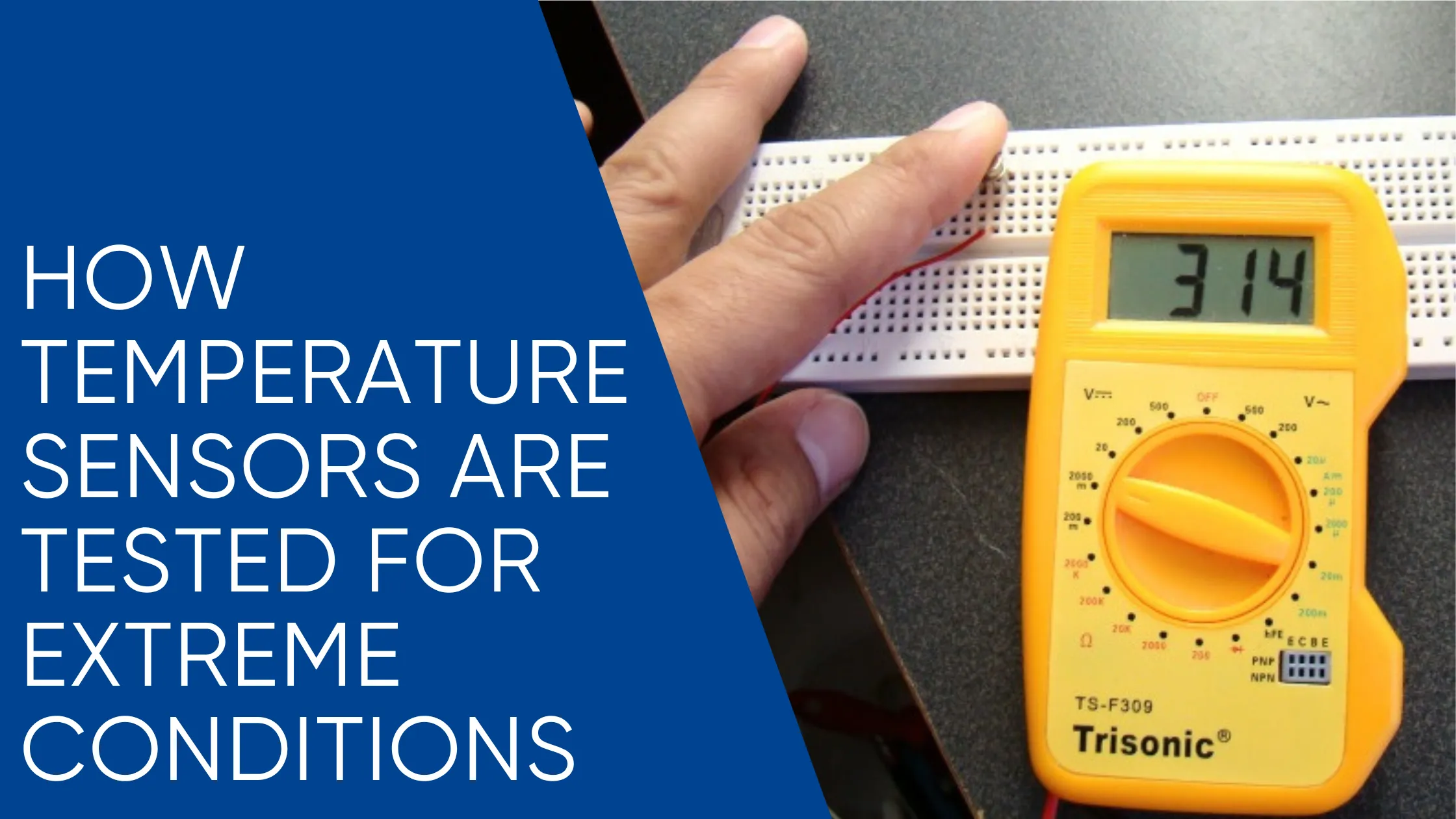
Look, you don't always have a lab. Sometimes you're on a factory floor or in your garage trying to figure out if a part is dead. If you're wondering how to check a temp sensor, the most common way is using a multimeter to check resistance.
Quick Guide: How to test a temperature sending unit
If you’re dealing with a car or a generator, knowing how to test a temperature sending unit is a life-saver.
- Check Resistance: Set your multimeter to Ohms. A healthy NTC sensor should show high resistance when cold and low resistance when hot.
- The "Boiling Water" Test: Dip the sensor tip in boiling water. If the resistance doesn't change smoothly, the sensor is "lagging" and needs to be replaced.
- Coolant Temperature Sensor Testing: For your car, coolant temperature sensor testing usually involves checking the voltage. If the ECU isn't seeing a steady voltage drop as the engine warms up, your cooling fan won't kick in, and you’re headed for an overheat.
- Pressure, Radiation, and Fatigue Tests
In industries like oil and gas, temperature isn't the only enemy. We subject our sensors to:
- Pressure Testing: Simulating deep-sea conditions to make sure the housing doesn't collapse.
- Radiation Testing: Critical for sensors going into medical X-ray machines or nuclear facilities. We check if the radiation changes the sensor’s color or strength.
- Fatigue Testing: We "cycle" the load-heating it up and cooling it down thousands of times, to simulate years of wear and tear in just a few days.
The JR Sensor Testing Checklist
We follow a strict protocol for Temperature sensor testing to ensure zero failure rates in the field.
| Test Type | What we're checking | Target Industry |
| High Temp | Oxidation & Stability | Power Plants / Steel Mills |
| Cryogenic | Brittleness & Contraction | Aerospace / Cold Chain |
| Corrosion | Salt spray & Acid resistance | Marine / Chemical Plants |
| Vibration | Mechanical Strength | Automotive / Military |
| NIST Traceable | Calibration Accuracy | Pharma / Food Labs |
Why Environmental Testing is a Game Changer
In India, humidity and dust are huge factors. A sensor might work in a clean lab in Germany but fail in a humid factory in Chennai. Our Temperature sensor testing includes salt spray and dust exposure.
This is especially important for coolant temperature sensor testing. These sensors live in a "soup" of hot chemicals and vibrations. If the seal isn't 100% perfect, the coolant will leak into the electronics and short them out. We test the seals under high pressure to make sure that never happens.
Final Thoughts
I always tell my team: "The sensor doesn't lie, but a poorly tested one can't tell the truth." Whether you are doing your own coolant temperature sensor testing at home or you're an engineer looking for a sensor that can survive a jet engine, the testing history is what matters.
At JR Sensors, we put in the work so you don't have to worry about a "meltdown" (literally). Our Temperature sensors are built to survive the dangerous situations, so you can stay safe.