To understand the difference between analog and digital sensors, it’s best to start with how they "speak.". The core difference lies in the output signal: analog sensors provide a continuous stream of data, while digital sensors provide data in discrete "chunks" or binary code. Ever wondered how your gadgets “feel” the world around them? From measuring heat to tracking light or pressure, sensors are the translators that turn physical phenomena into electronic data. The difference between analog and digital sensors isn’t just technical, it shapes how accurately, quickly, and efficiently your devices respond.
Understanding the analog sensor and digital sensor distinction helps you pick the right technology for the right application. Let’s break down the difference between analog and digital sensors in a way that actually makes sense.
Analog Sensors: The Continuous Stream
Let’s start with analog sensors. Think of them as the storytellers of the physical world. They don’t just send snapshots; they provide a continuous stream of data, flowing smoothly like a river.
The output, usually voltage or current, directly mirrors what’s happening in real time. Whether it’s temperature rising, light intensity shifting, or pressure changing.
Because of this continuous nature, analog sensors can capture even the tiniest variations, making them incredibly precise for many applications. The difference between analog and digital sensors starts to become clear here: analog is smooth, detailed, and uninterrupted.
- Signal Type: Sine waves or smooth curves.
- Resolution: Theoretically infinite. Because the signal is continuous.
- Real-World Example: A standard mercury thermometer. As it gets hotter, the mercury rises smoothly and can stop at any point on the scale.
- Electronic Example: A LDR (Light Dependent Resistor). As light intensity increases, its resistance changes in a smooth, uninterrupted curve.
Also Read: Types of Marine Sensors Used in Boats and Ships
Digital Sensors: The Binary Logic
Instead of sending a smooth, continuous signal, they convert what they sense into binary data. 0s and 1s. Most digital sensors have a tiny brain inside (an ADC) that does the math for you and sends clean, precise output.
This makes them highly reliable over long distances or in noisy environments. So when comparing analog sensor and digital sensor, the difference is obvious: continuous vs discrete, smooth vs precise, classic vs modern.
- Signal Type: Square waves or discrete pulses.
- Resolution: Finite. It is limited by the number of "bits" (e.g., an 8-bit sensor has 256 possible levels).
- Real-World Example: A digital thermometer. It doesn't show a moving line; it shows a specific number (like 98.6°F), jumping from one decimal to the next.
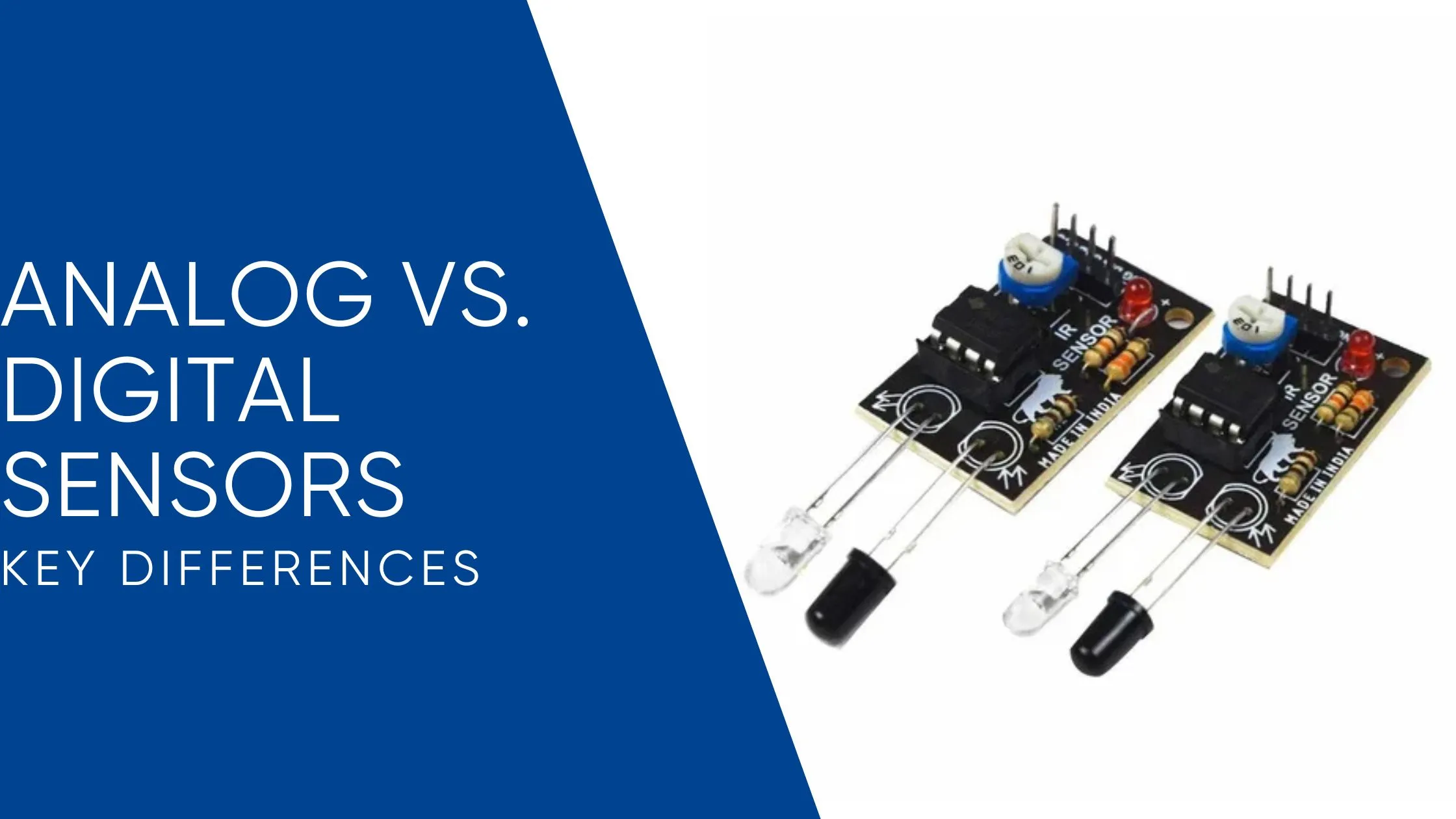
- Electronic Example: A DHT11 Temperature Sensor. It measures heat but sends the data to your computer as a string of binary code.
Key Differences Between Analog and Digital Sensors
Analog sensors give you a smooth, continuous stream of data, like watching a dial move in real time. Digital sensors, on the other hand, give clean, discrete numbers or pulse like reading a digital screen.
| Feature | Analog Sensors | Digital Sensors |
| Output | Continuous voltage/current | Discrete binary (0s and 1s) |
| Noise | Sensitive to interference | Highly robust |
| Accuracy | Can degrade over distance | Consistent and reliable |
| Complexity | Simple hardware, needs processing | Smart hardware, easy integration |
| Example | LDR, Mercury thermometer | DHT11, Digital thermometer |
So the difference between analog and digital sensors is not just technical it’s how they “talk” to your devices. One whispers continuously, the other speaks in clear, exact words.
Also read: Baby Temperature Safety Sensors
Performance Differences: Noise, Distance & Processing
Now, let’s talk about why analog sensor and digital sensor behavior matters in real life. Analog signals are smooth but fragile, running a wire near power cables can cause interference, making readings wobble. Digital sensors are much tougher; even if there’s some noise, the 0s and 1s remain clear.
Analog sensors also lose strength over long wires, while digital signals can travel farther without corruption. Plus, analog data usually needs a device like an Arduino to do the heavy math, whereas digital sensors often send the final number directly. Easy and precise.
Conclusion
Understanding the difference between analog and digital sensors shapes how you design, monitor, and troubleshoot electronic systems. Analog sensors give you smooth, continuous insights, perfect for detecting subtle changes, while digital sensors deliver precise, noise-resistant data ideal for modern microcontroller-driven applications.
By knowing when to use an analog sensor and digital sensor, or how analog modulation differs from digital modulation, you can optimize performance, reliability, and efficiency across any electronic or automotive project.