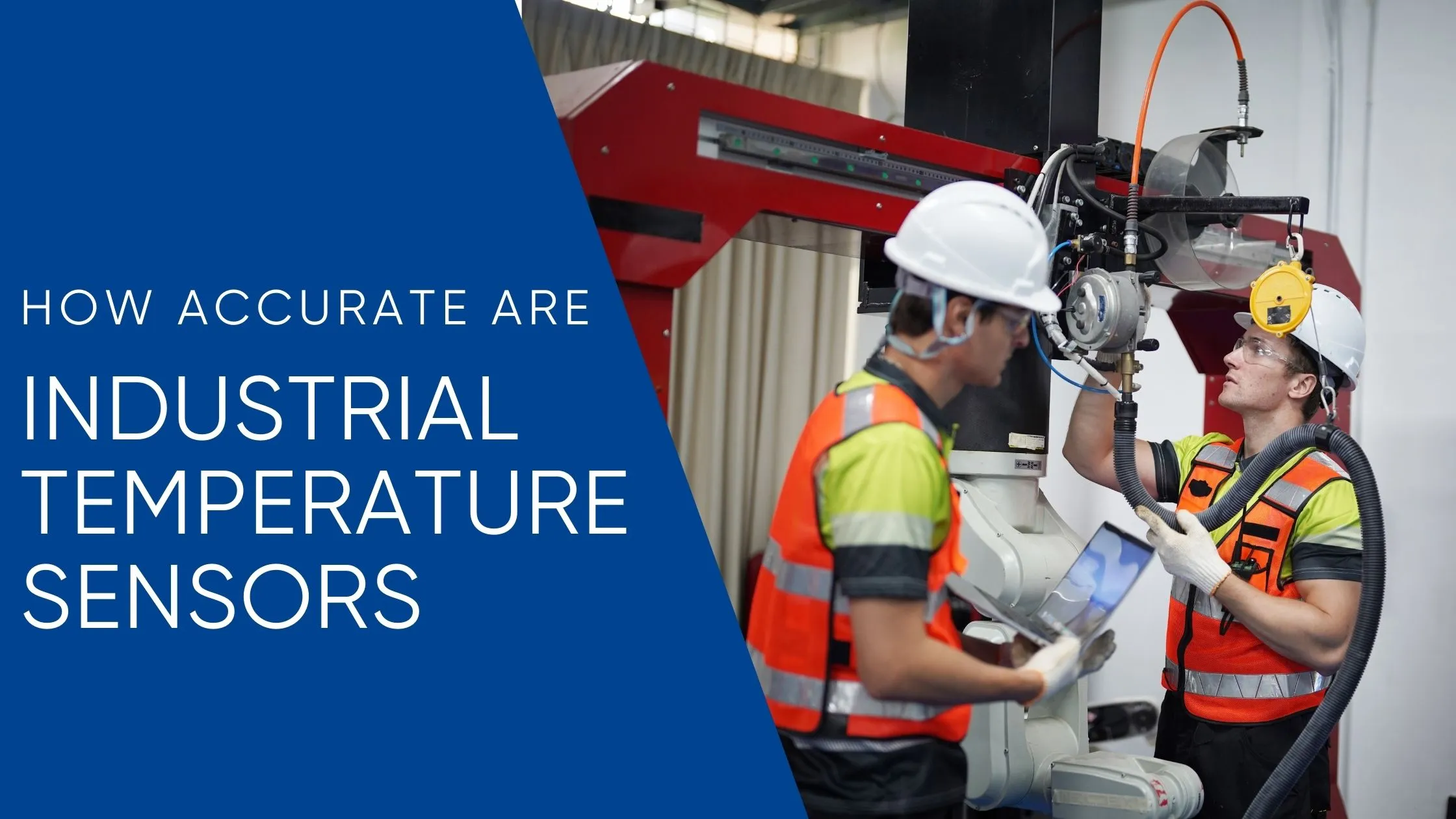
How Accurate Are Industrial Temperature Sensors? Factors That Affect Performance
How Accurate Are Industrial Temperature Sensors? Factors That Affect Performance
In an industrial plant, temperature is not just a number on a screen. It decides whether a batch passes quality checks, whether a machine runs safely, or whether a process quietly fails without anyone noticing. I’ve seen engineers obsess over a 1°C deviation and honestly, they’re right. In industries like pharma, food, steel, or EV batteries, that small gap can mean huge losses.
So the big question is: how accurate are industrial temperature sensors, really? And more importantly, what messes up that accuracy?
Let’s break it down in a simple way.
What Does Temperature Sensor Accuracy Actually Mean?
Temperature accuracy simply means how close the sensor reading is to the real temperature. The closer it is, the better the sensor accuracy.
But accuracy is not just about buying an expensive sensor. It’s about how it’s installed, calibrated, maintained, and protected.
Industrial sensors follow global standards so that readings stay consistent worldwide:
- Thermocouples: IEC 60584-1
- RTDs (Pt100, Pt1000): IEC 60751
These standards define tolerance classes. For example, a Class AA RTD is way more precise than a standard Class B RTD.
Typical Accuracy Ranges of Industrial Temperature Sensors
Here’s a simple comparison that engineers actually care about:
| Sensor Type | Typical Accuracy | Best Use Case |
| RTD (Pt100) | ±0.1°C to ±0.5°C | High precision industries |
| Thermocouple | ±0.5°C to ±2.2°C | Extreme temperatures |
| Thermistor | ±0.05°C to ±0.2°C | Narrow range, high sensitivity |
If you’re chasing high temperature accuracy, RTDs and thermistors usually win. Thermocouples shine when things get insanely hot.
5 Key Factors That Affect Temperature Sensor Accuracy
Even the most accurate temperature sensor can give wrong readings if these things are ignored.
1. Sensor Drift (The Silent Accuracy Killer)
No sensor stays perfect forever. Over time, sensors drift due to:
- Thermal cycling
- Chemical exposure
- Mechanical stress
Your sensor might still “work,” but the reading slowly shifts.
Fix: Follow a strict temperature sensor calibration procedure instead of waiting for failures.
2. Immersion Depth (Most People Ignore This)
If a sensor is not inserted deep enough into the process fluid or surface, heat escapes through the stem. This is called stem conduction error.
Result? The sensor reads lower than the actual temperature.
Fix: Ensure proper immersion length (usually 10–15x sensor diameter).
3. Lead Wire Resistance (RTD Users, Pay Attention)
RTDs measure resistance. But guess what? The connecting wires also have resistance.
- 2-wire RTDs = more error
- 3-wire RTDs = better
- 4-wire RTDs = highest sensor accuracy
Fix: Use 3-wire or 4-wire setups for industrial applications.
4. Cold Junction Compensation (Thermocouples Only)
Thermocouples measure temperature difference, not absolute temperature. If the cold junction temperature is wrong, your entire reading shifts.
This directly affects the accuracy of a thermocouple.
Fix: Use transmitters with high-quality CJC and stable ambient conditions.
5. Environmental Interference (EMI, Vibration, Moisture)
Industrial plants are noisy electrically. Motors, VFDs, high-voltage lines—they all create EMI that corrupts sensor signals.
Fix:
- Shielded cables
- Proper grounding
- Industrial-grade connectors
This is underrated but huge for sensor accuracy.
7 Common Mistakes in Temperature Sensor Calibration
Calibration is where most industries mess up. And bad calibration is worse than no calibration.
Here are real mistakes I’ve seen:
- Not waiting for stabilization – sensors need thermal equilibrium.
- Using uncertified reference probes – your reference must be traceable.
- Loose placement in dry-blocks – poor heat transfer = wrong readings.
- No documentation – auditors will not accept undocumented calibration.
- Drafts or sunlight during calibration – yes, this matters.
- Ignoring “as-found” data – you lose drift history.
- Wrong calibration equipment – liquid bath vs dry-block vs blackbody matters.
A proper temperature sensor calibration procedure is not optional in regulated industries.
RTD vs Thermocouple: Which Is More Accurate?
This is one of the most searched questions (and asked by every B2B buyer).
RTDs:
- Higher temperature accuracy
- Stable long-term
- Best for pharma, food, labs
Thermocouples:
- Wide temperature range
- Rugged
- Slightly lower accuracy of a thermocouple compared to RTD
If accuracy is the top priority, RTD usually wins.
How to Choose an Accurate Temperature Sensor (Buyer Checklist)
If you’re a plant manager, procurement head, or OEM, ask these questions:
- What accuracy class do I need?
- What temperature range?
- Will EMI be high?
- How often will calibration happen?
- Is 4-wire RTD feasible?
- Do I need fast response time?
Choosing the right accurate temperature sensor is not about price. It’s about application risk.
Why Temperature Accuracy Matters in Real Industries
Temperature errors can cause:
- Product recalls (pharma, food)
- Battery degradation (EVs)
- Process inefficiency (chemical plants)
- Equipment damage (steel & furnaces)
Even a 2°C error can cost lakhs in industrial processes. That’s why sensor accuracy is now considered a safety parameter, not just a quality metric.
How JR Sensor Ensures High Accuracy in Industrial Applications
At JR Sensor, precision is not a buzzword, it’s the core engineering goal.
We focus on:
- High-stability RTDs and thermistors
- Industrial-grade thermocouples
- Custom calibration support
- EMI-resistant sensor assemblies
- Application-specific sensor design
Whether you need sensors for EV batteries, industrial automation, or process industries, the right sensor design and calibration strategy makes all the difference.
Conclusion: Accuracy Is a System, Not Just a Sensor
Industrial temperature sensing is not about buying a sensor and forgetting it. It’s about installation, environment, wiring, calibration, and monitoring drift over time.
If you understand temperature accuracy, follow a structured temperature sensor calibration procedure, and choose the right accurate temperature sensor, your process stays stable, safe, and profitable.
And honestly, in modern industries, accuracy is not a luxury. It’s survival.