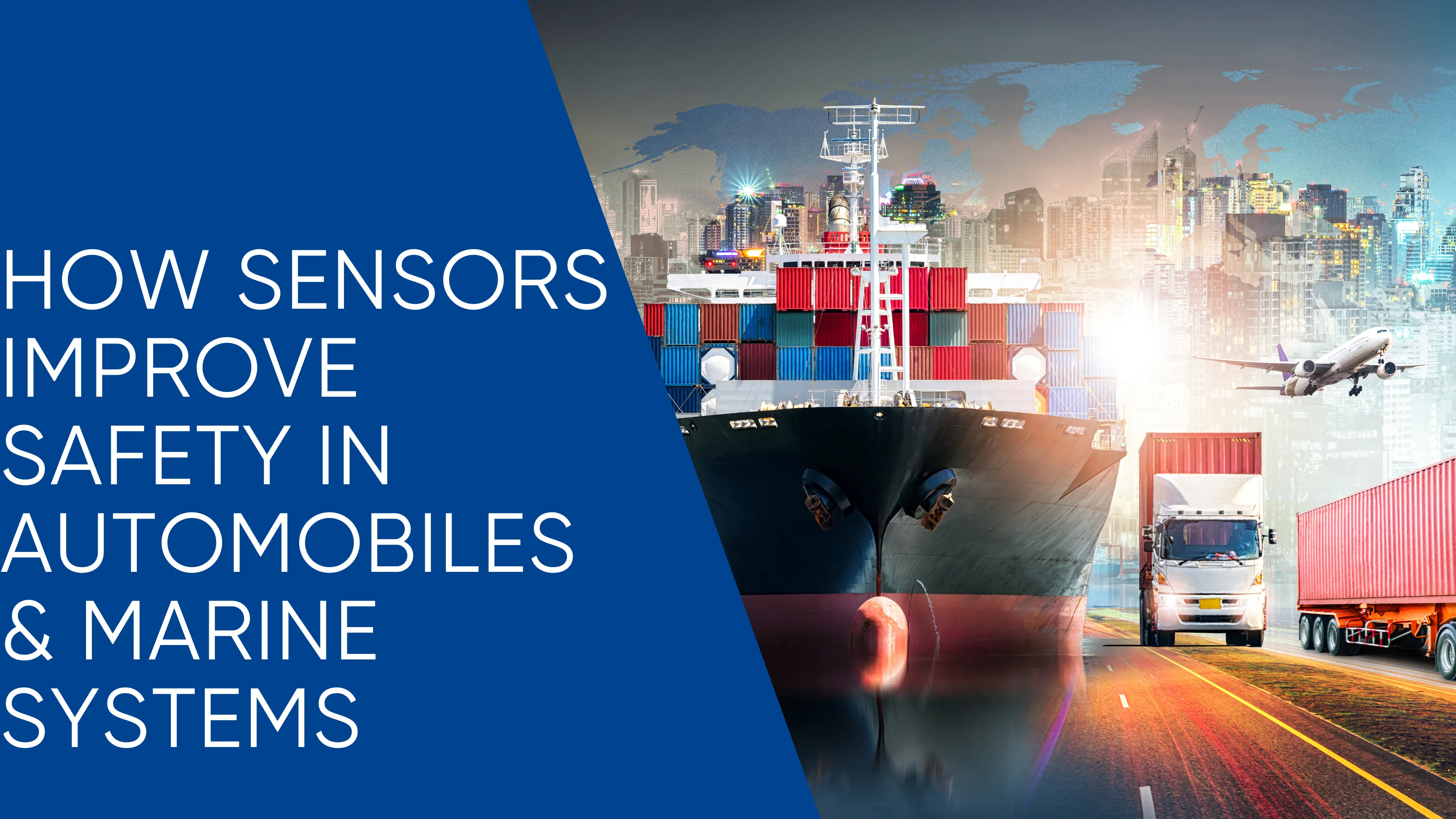
You know that tiny beep your car makes when you’re this close to hitting a wall? Or how ships somehow “see” danger even in pitch darkness? That’s sensors quietly doing their job, saving lives while we’re busy driving, sailing.
Today, automotive sensors and marine sensors have become the real safety heroes. Every car sensor, every smart motion sensor, every bit of data flowing inside modern vehicles is constantly watching, measuring, and correcting before things go wrong. From everyday auto sensors that help with parking, braking, and stability, to advanced autonomous driving sensors that make split-second decisions, safety is no longer just about strong metal, it’s about smart sensing.
And whether it’s understanding the types of sensors in cars, the types of sensors in automobile systems, or how marine vessels stay safe in unpredictable waters, one thing is clear: sensors are now the eyes, ears, and sometimes the brain of modern transportation.
Automotive Safety: Where Sensors Prevent Accidents Before They Happen
In cars, safety is no longer just about airbags and seatbelts. It’s about anticipation. Modern vehicles rely on a complex network of automotive sensors that continuously monitor surroundings, driver behavior, and vehicle performance.
Broadly, these fall into two categories: Active Safety (to avoid accidents) and Passive Safety (to reduce damage when accidents happen).
Key Automotive Sensors That Save Lives
- Radar & LiDAR Sensors
- These are the backbone of autonomous driving sensors. Radar detects distance and speed even in rain or fog, while LiDAR creates a detailed 3D map of surroundings. Together, they power systems like Adaptive Cruise Control and Automatic Emergency Braking.
- Ultrasonic Sensors
- Found in bumpers, these help with parking assistance and low-speed obstacle detection. Simple? Yes. Life-saving in tight spots? Also yes.
- Accelerometers
- These tiny sensors instantly detect sudden deceleration and trigger airbag deployment within milliseconds.
- TPMS (Tyre Pressure Monitoring System)
- A critical car sensor that warns drivers before a tyre blowout turns dangerous, especially at high speeds.
- Driver Monitoring Systems (DMS)
- Using cameras and sensors, these systems detect drowsiness or distraction. Because sometimes the biggest risk isn’t the road, it’s us.
Understanding the types of sensors in cars or the types of sensors in automobile safety systems makes one thing very clear: modern cars don’t just react, they think ahead.
Marine Safety: When Sensors Guard Lives in the Unknown
If roads are unpredictable, the sea is downright unforgiving. Marine environments demand sensors that can survive corrosion, pressure, saltwater, and zero visibility.
That’s where marine sensors step in.
Essential Sensors Used in Marine Safety
- SONAR (Sound Navigation and Ranging): Ships don’t rely on vision underwater. Sonar helps detect submerged obstacles, map seabeds, and prevent groundings.
- AIS (Automatic Identification System): This system uses GPS and communication sensors to track nearby vessels, reducing the risk of mid-sea collisions.
- Structural Health Sensors Strain gauges and vibration sensors monitor hull integrity, especially crucial during storms and heavy loads.
- Environmental Sensors: Ultrasonic wind sensors provide real-time wind data without moving parts (important, because corrosion is real). Gas and oil spill sensors detect leaks before they become disasters.
Unlike cars, marine safety focuses less on speed and more on survival. Still, the philosophy remains the same: sense early, react fast.
Comparison at a Glance: Automotive vs Marine Sensors
| Feature | Automobile Sensors | Marine Sensors |
| Primary Goal | Collision avoidance & passenger safety | Safe navigation & vessel integrity |
| Environment | Roads, traffic, weather | Open seas, saltwater, pressure |
| Key Technologies | Radar, LiDAR, Cameras, TPMS | SONAR, AIS, GPS, Wind Sensors |
| Critical Risk | High-speed impact | Grounding, hull failure |
Real-World Examples You’ve Probably Experienced
- Your car automatically braking when someone cuts in front of you? That’s automotive sensors working together.
- A parking assist beep saving your bumper? Ultrasonic auto sensors doing their thing.
- A ship safely docking despite strong winds? Marine wind sensors and navigation systems.
- A dashboard warning before tyre pressure drops dangerously? That one car sensor just saved a bad day.
Once you notice them, you’ll realize sensors are everywhere.
The Future of Safety: Sensor Fusion
The future isn’t about one sensor, it’s about sensor fusion. This means combining data from multiple sensors to create a more accurate understanding of reality. If a camera fails due to sunlight glare, radar still sees. If GPS is unstable at sea, inertial and sonar sensors keep navigation intact.
This approach is already transforming autonomous driving sensors and next-gen marine systems.
Why JR Sensors Matters in Safety-Critical Applications
At JR Sensors, sensing solutions are designed with one clear focus-reliability in real-world conditions. Whether it’s automotive sensors operating at high speeds or marine sensors exposed to moisture, vibration, and corrosion, every product is built to perform consistently, not just in labs but out on the road and at sea.
From car sensors used in braking, engine monitoring, and motion detection to auto sensors supporting next-generation safety systems, JR Sensors emphasizes precision, durability, and fast response. The same engineering mindset extends to marine applications, where sensor failure is not an option.
By combining robust design, automotive-grade protection, and application-specific customization, JR Sensors supports safer mobility on land and on water.
Final Thoughts
Whether it’s a smart motion sensor inside a car or advanced marine sensors guiding vessels across oceans, one truth stays the same: modern safety depends on sensing, not guessing. From everyday car sensors to complex navigation systems, sensors don’t just improve safety, they redefine it.
And the more we understand the types of sensors in cars and marine systems, the more we realize how much quiet intelligence is working nonstop to protect lives. Because the best safety systems aren’t loud. They’re simply always awake.