I remember the first time I tried to wire a sensor to a controller back in the day. I thought, "It's just two wires, how hard can it be?" Ten minutes later, I was staring at a screen showing 0 degrees while the heater was literally glowing red. The sensor was working, but the "brain" wasn't listening.
In the industrial and automotive world, Temperature sensors are like our eyes, but Programmable Logic Controllers (PLCs), Electronic Control Units (ECUs), and Battery Management Systems (BMS) are the brains. If they don't talk to each other perfectly, you don't just get a wrong reading, you get a system failure.
At JR Sensors, we don't just make the "eyes." We make sure they speak the right language for your controllers. Here is how that integration actually works in the real world.
1. The Industrial Brain: Programmable Logic Controllers (PLCs)
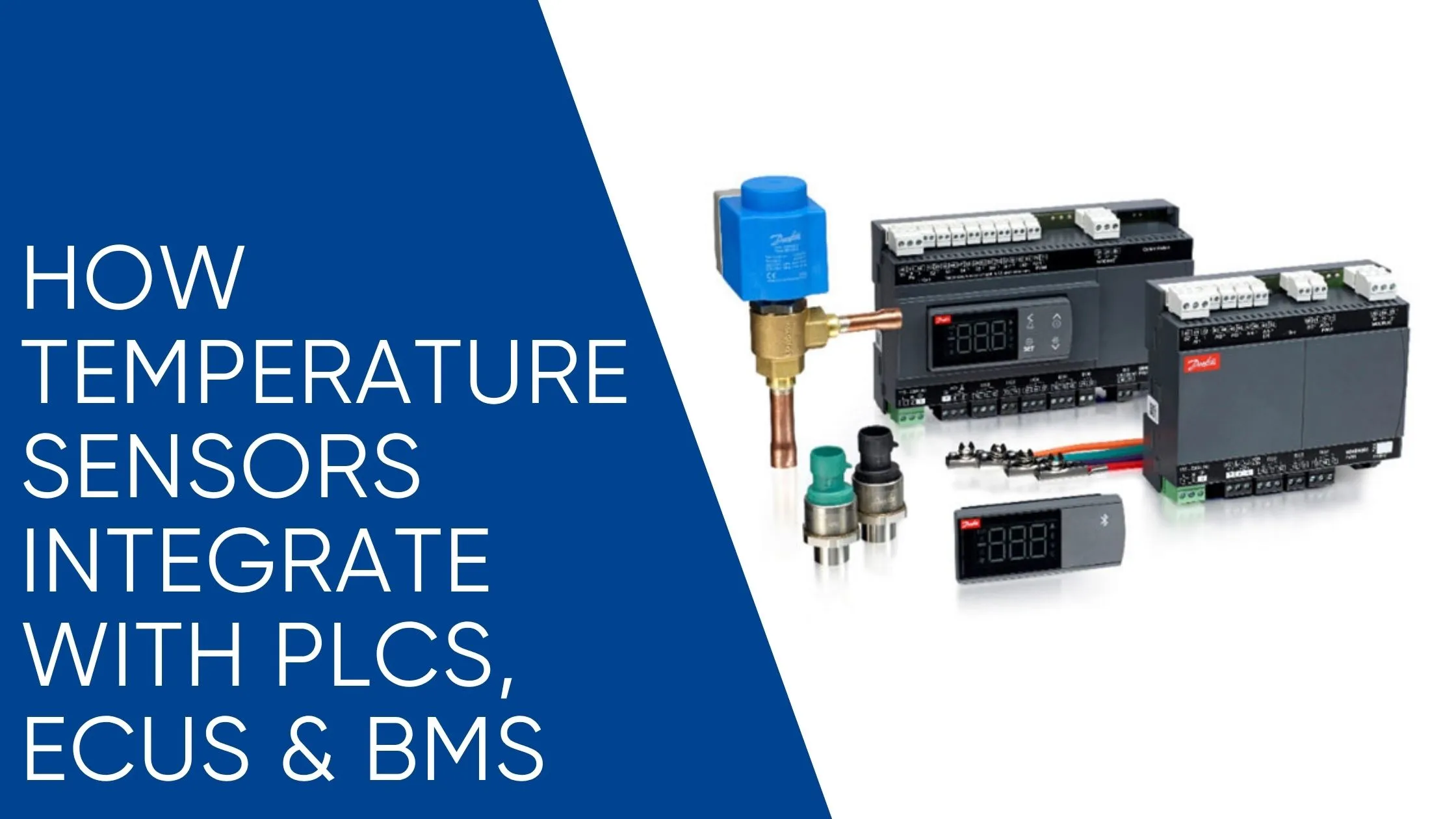
If you’re in a factory, Programmable Logic Controllers are the bosses. Whether it’s a Siemens S7-200 or an Allen-Bradley, the PLC needs to take a raw signal from a sensor and turn it into an action (like turning on a fan).
The Role of Temperature Modules
You can't usually just poke a wire into a PLC. You need Temperature Modules (like the EM235). These modules act as translators. They take the resistance from a PT100 or the tiny voltage from a thermocouple and convert it into a digital value the PLC understands, usually a 4-20mA current signal. This is great because current signals don't get "noisy" even if the wire is 50 meters long!
2. The Automotive Brain: Electronic Control Units (ECUs)
In your car, the Electronic Control Units are constantly juggling data. The ECU needs to know if the engine is overheating or if the intake air is too dense.
Unlike the heavy-duty modules in a factory, Electronic Control Units often rely on NTC thermistors. These are tiny, rugged sensors where the resistance drops as it gets hotter. The ECU sends a "reference voltage" to the sensor, measures what comes back, and uses a lookup table to say, "Okay, the engine is at 90 degrees, keep the fan off."
3. The EV Powerhouse: Battery Management Systems (BMS)
If you’re driving an Electric Vehicle (EV), the Battery Management Systems are the most stressed-out brains in the car. Lithium batteries are "divas", they hate being too hot or too cold.
The BMS uses a network of NTC thermistors tucked between the battery cells. If the Battery Management Systems detect a "hot spot" in even one cell, they can throttle the power or kick the cooling system into high gear. This isn't just about performance; it’s about preventing a fire.
Integration Methods: How They Connect
| Controller Type | Common Sensor | Typical Interface | Logic Style |
| PLC | PT100 / Thermocouple | Temperature Modules (4-20mA) | PID / Fuzzy Logic |
| ECU | NTC thermistors | Voltage Divider (Analog) | Lookup Tables |
| BMS | High-precision NTC | I2C / CAN bus / Daisy-chain | Safety Thresholds |
4. The Magic of Fuzzy PID Control
Most people think controllers just turn "On" or "Off." But modern Programmable Logic Controllers use something called Fuzzy PID Control.
- Traditional PID: It’s math-heavy. It looks at the error and tries to fix it based on a set formula.
- Fuzzy Logic: It imitates human thinking. Instead of "Temperature is 50.1," it thinks, "The temperature is getting a bit warm, let’s slightly speed up the fan."
By combining these, Temperature sensors provide the raw data, and the PLC uses Fuzzy PID to make sure the temperature stays rock-steady without "overshooting" (where the heater gets too hot and then the fan gets too cold). It’s much more stable and keeps your equipment alive longer.
5. Why Precision in NTC Thermistors Matters
Whether it's for Electronic Control Units or Battery Management Systems, you can't use "cheap" sensors. If your NTC thermistors have a 5% error margin, your BMS might think the battery is at 45 degrees C when it's actually at 52 degrees C. That’s the difference between a safe drive and a thermal runaway event.
At JR Sensors, we focus on high-stability NTC thermistors that don't "drift" over time. When your Battery Management Systems ask for a reading, they get the truth, every single time.
6. Software Design: The "Handshake"
The software side (like Siemens STEP7 or MATLAB) is where the "handshake" happens.
- Initialization: The PLC sets its "goal" (Set Point).
- Collection: Temperature sensors send the analog signal.
- Conversion: The A/D converter turns the signal into a real number.
- Calculation: The Fuzzy PID algorithm decides the output.
- Action: The Implementation module kicks the fan or heater into gear.
Final Thoughts from JR Sensors
Integration is where the "hardware" meets the "brains." You can have the most expensive Programmable Logic Controllers in the world, but if your Temperature sensors are low-quality or the Temperature Modules aren't calibrated, your system is flying blind.
Whether you're building a boiler control system or a new EV battery pack, make sure your sensors and controllers are on the same page. At JR Sensors, we’ve spent years perfecting that connection so you don't have to worry about it.