I remember talking to a guy at a trade show last year who thought he could save a few bucks by using a standard car coolant sensor in a high-pressure steam line at his factory. Let’s just say it didn’t end well. The sensor didn't just fail; it practically melted into the housing.
It’s a common mistake. People see automotive sensors and think, "Hey, if it can handle an engine, it can handle my machine." But the truth is, industrial temperature sensor tech and vehicle sensors are built for totally different worlds.
At JR Sensors, we get asked about this a lot. So, let’s clear the air on how these different types of temperature sensors actually stack up against each other.
The Environment: "Rough" vs. "Brutal"
When we talk about types of sensors in cars, we’re talking about components designed for a predictable set of extremes. Yes, an engine gets hot, but it usually stays between -40 degrees C and +125 degrees C.
An industrial temperature sensor, however, might be shoved into a furnace at 800 degrees C or a cryogenic freezer at -200 degrees C. In a factory, you also have to deal with high-pressure washdowns, corrosive chemicals, and massive electromagnetic interference (EMI) from giant motors that would fry most types of sensors in automobile systems.
Reliability and Life Cycles
Here is the "secret" about automotive sensors: they are built for a vehicle that’s expected to run for maybe 5,000 to 10,000 hours over its lifetime.
Industrial sensors are the marathon runners. An industrial temperature sensor in a power plant is expected to run 24/7 for years without being touched. If a sensor in your car fails, you get a "Check Engine" light and a trip to the garage. If a bearing temperature sensor fails in a mining conveyor, you’re looking at lakhs of Rupees in lost production every hour.
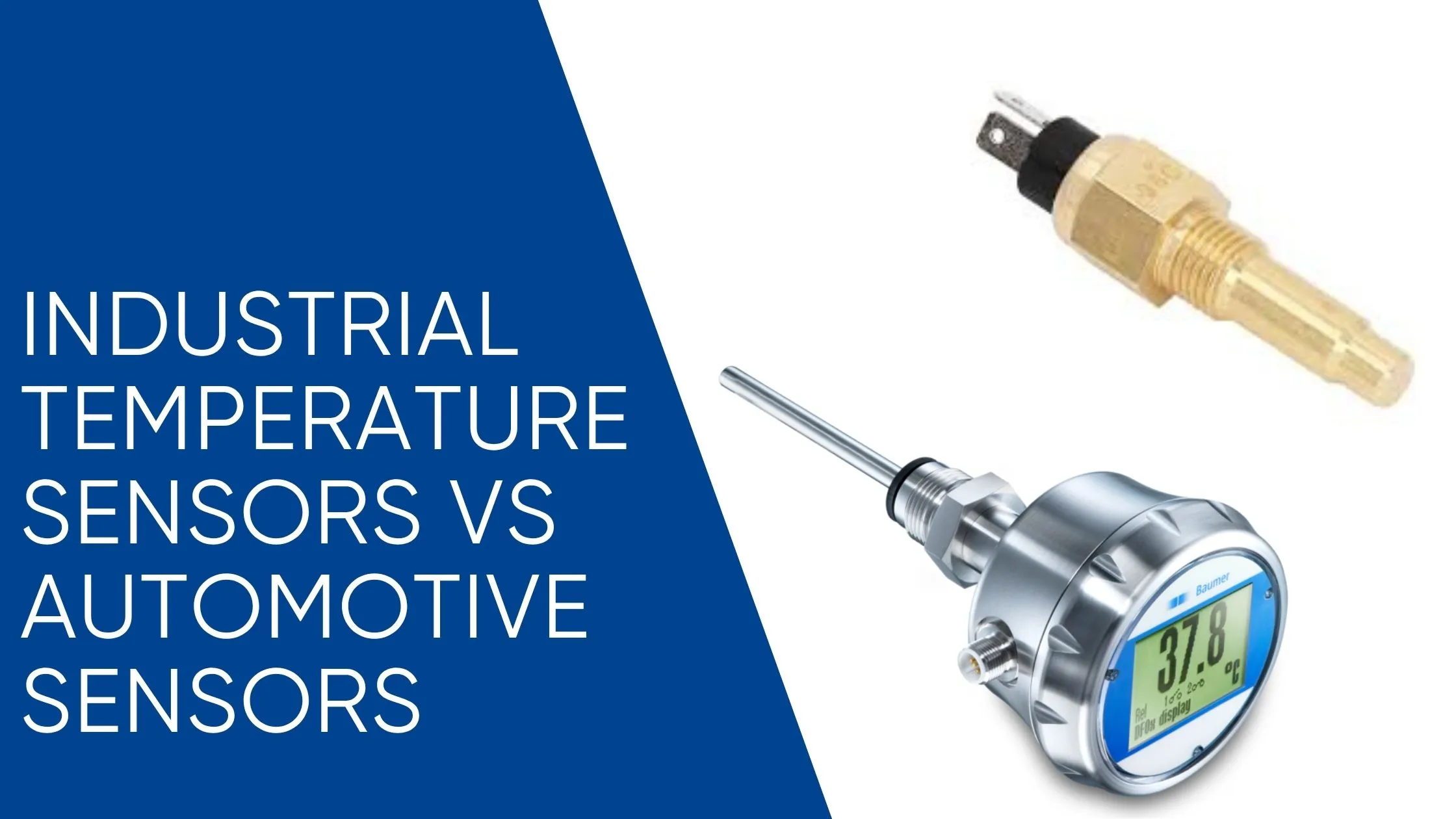
Difference Between Industrial and Automotive Temperature Sensors
If you're trying to decide which "grade" you need, check out this breakdown:
| Feature | Automotive Sensors | Industrial Sensors |
| Typical Range | -40 to +150 | -200 to +800 |
| Output Signal | Often 0-5V or CAN bus | 4-20mA, Modbus, or HART |
| Housing | Plastic or lightweight alloy | Heavy-duty Stainless Steel / Ceramic |
| Durability | High vibration, low chemical | High vibration, high chemical, high pressure |
| Cost | Mass-produced, lower cost | Specialized, higher precision cost |
4. Specialized Industrial Applications
In the industrial world, we have "niche" sensors you'd never find in a car. Take the bearing temperature sensor, for example. These are tiny, rugged probes that sit inside motor housings to detect friction heat before a bearing seizes. If you tried to use one of the standard types of sensors in cars here, it wouldn't have the "response time" or the shielding to survive the magnetic field of a 500HP motor.
We also deal with the pressure and temperature sensor combo units. In hydraulics or steam systems, you need to know both values at the exact same spot to calculate "enthalpy" or flow rates. While some vehicle sensors do this (like T-MAP sensors), the industrial versions are built to handle pressures up to 600 bar.
5. The "Symphony" of Automotive Sensors
Don't get me wrong, types of sensors in automobile systems are incredibly smart. Modern types of sensors in cars act like a symphony. You have:
- Oxygen Sensors: To tweak fuel-air mix.
- Hall-Effect Sensors: For timing the engine.
- Ultrasonic Sensors: For parking (the "beeps").
- Knock Sensors (Piezoelectric): To listen for "pings" in the engine.
The complexity of automotive sensors is in their communication with the ECU, whereas the complexity of an industrial temperature sensor is in its survival against the elements.
6. Can You Cross the Streams?
Rarely. You can sometimes use industrial-grade tech in a high-performance race car (we see this a lot with high-end Pt100 RTDs), but you almost never want to go the other way.
Using vehicle sensors in an industrial setting usually leads to "drift." This is where the sensor starts giving slightly wrong readings over time because the industrial environment is just too "noisy" or hot for the sensor's internal calibration. For Industrial Safety, drift is your worst enemy.
Final Thoughts from JR Sensors
Whether you’re looking for a bearing temperature sensor for your plant or trying to understand the different types of temperature sensors for a new project, the "grade" matters more than the price.
At JR Sensors, we bridge that gap. We use IATF 16949:2016 (automotive standards) for our manufacturing quality, but we build for industrial-strength performance. We believe in accuracy that meets innovation, so you get a sensor that survives the furnace and gives you the precision of a lab instrument.