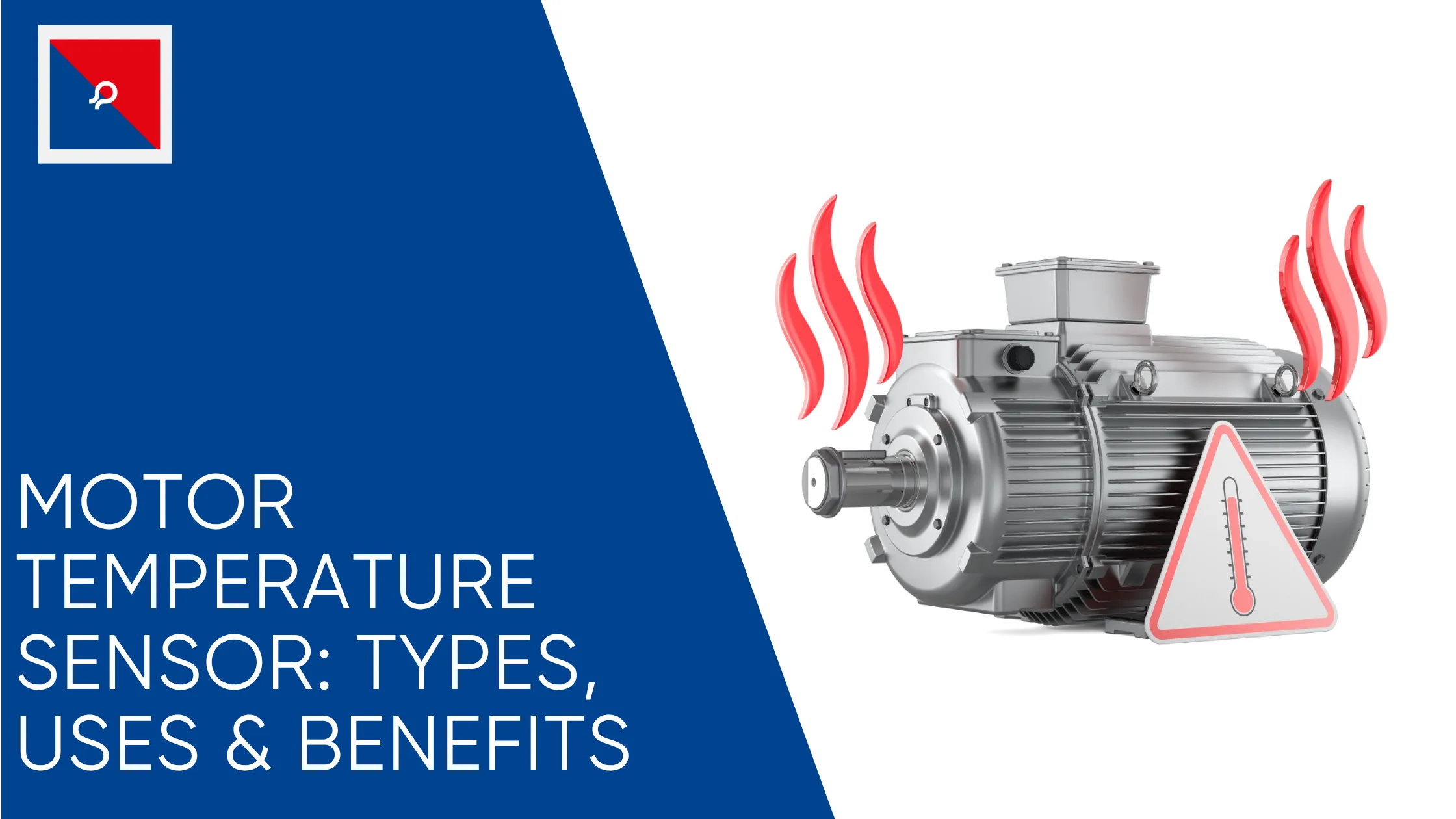
A motor temperature sensor monitors an electric motor's temperature and helps detect overheating before excessive heat damages its windings, insulation, or other critical components. Used in industrial motors, pumps, conveyors, and manufacturing equipment, these sensors provide temperature data that can trigger alarms or protective actions when connected to a suitable monitoring or control system.
Depending on the application, manufacturers may use NTC thermistors, PTC thermistors, RTDs, or thermocouples to measure motor temperature. The right choice depends on the required accuracy, response time, operating temperature range, installation location, and protection requirements.
In this guide, we'll explain how motor temperature sensors work, where they are installed, the different types available, and how to select a suitable sensor for reliable industrial motor monitoring.
How Does a Motor Temperature Sensor Work?
A motor temperature sensor detects temperature changes and converts them into an electrical signal that a monitoring or control system can interpret. The signal depends on the sensing technology used.
For example, an NTC thermistor changes its resistance as temperature changes, while an RTD provides a predictable resistance variation that can be measured to determine temperature.
The response depends on the sensor type, control hardware, configuration, and protection strategy. A sensor alone does not automatically shut down a motor; it must be integrated with a suitable monitoring or control system.
Why Do Electric Motors Overheat? Common Causes and Risks
Electric motors generate heat every time they run, that's just physics. Under normal load, this heat is manageable and gets dissipated as designed. The trouble starts when a motor is overloaded, runs continuously without proper cooling, sits in a dusty or poorly ventilated space, or develops a fault like a bearing issue or winding insulation breakdown.
Once heat starts building up faster than it can escape, things go downhill fast. Insulation on the motor windings begins to degrade, efficiency drops, and if nothing intervenes, the motor can burn out completely. This is exactly why an electric motor temperature sensor isn't a nice-to-have anymore, on most industrial equipment, it's considered basic protection.
Where Is a Motor Temperature Sensor Located?
Here's something people often get wrong: they assume the sensor just measures the outside casing temperature. In most serious applications, that's not where the real risk is. The windings are where heat builds up fastest and where damage actually starts, so a motor winding temperature sensor is usually embedded directly into the winding itself, right where it matters.
This placement matters a lot. A sensor sitting on the motor housing might show a comfortable reading while the windings underneath are already overheating. By the time the outer casing warms up enough to register a problem, the internal damage could already be done. That's why manufacturers building anything beyond basic motors tend to insist on embedded winding sensors rather than relying on surface measurement alone.
Types of Motor Temperature Sensors and Their Applications
A few sensor types dominate this space, and each one suits a slightly different need.
Thermistors, particularly NTC types, are popular because they're compact, respond quickly, and are inexpensive to integrate directly into windings. PTC thermistors work a bit differently — their resistance jumps sharply at a set temperature, which makes them well suited as a straightforward cutoff switch rather than a continuous reading device.
RTDs, like PT100 sensors, are the go-to when accuracy matters more than speed. They're common in larger or more critical motors where a precise reading is worth the slightly slower response time.
Thermocouples come into play when the operating environment is genuinely extreme — very high ambient heat, harsh industrial settings, that sort of thing. They're tougher and can handle wider temperature ranges, though they're less common in standard motor applications.
Benefits of Motor Temperature Monitoring for Industrial Equipment
It's easy to think of a motor temperature sensor purely as a failure-prevention tool, but that's only half the story. The data it provides feeds into how a plant manages maintenance overall. Instead of waiting for a motor to fail and then scrambling to fix it, operators can watch temperature trends over weeks or months and schedule maintenance before anything actually breaks.
This shift, from reactive repairs to planned intervention, is where the real value shows up. A motor that's monitored properly tends to run more efficiently too, since consistent overheating quietly eats into performance long before it causes outright failure.
Industrial Applications of Electric Motor Temperature Sensors
Think about a conveyor system running continuously in a manufacturing plant, or a pump motor operating in a hot, enclosed utility room. In both cases, a electric motor temperature sensor feeding data to a PLC can trigger an alarm, cut motor speed, or shut the system down safely if temperatures climb past a safe threshold. Multiply that across dozens or hundreds of motors in a facility, and the cumulative savings in avoided downtime and equipment replacement add up quickly.
How to Choose the Right Motor Temperature Sensor?
If you're specifying sensors for motor protection, a few things are worth prioritizing: correct placement within or close to the windings, a response time suited to how quickly the motor's load can change, and a sensor rated for the actual thermal environment it'll face, not just typical operating conditions.
A motor winding temperature sensor is a small part of an overall system, but it's often the single component standing between normal operation and an expensive failure. Getting it right isn't complicated, but it does need to be treated as a core design decision rather than an afterthought.
Looking for a suitable motor temperature sensing solution? JR Sensors provides temperature-sensing solutions for application-specific requirements.
Contact the JR Sensors team to discuss your motor temperature monitoring application, technical specifications, and sensor integration needs.